PersekOS
A local operating stack for agents, work, memory, cadence, evidence, and life operations. The agent council is one layer. The system around it is the bigger build.
PersekOS started as a way to learn as much as possible, as fast as possible. I built things, found better ways to do them, rebuilt them, scrapped parts I no longer needed, and kept changing the system as the models got better.
Over time, it has shifted from pure learning mode into something more intentional: a set of components I can keep using as AI changes. The mechanics may change every few months. The outputs matter more. Intelligence briefings, durable project context, working memory, and decision history can keep carrying forward even when I swap the tools underneath them.
It is made of many components: the agent council, my local operating layer, coordination, memory, review loops, durable project artifacts, and the specific systems that produce briefs, project context, and reusable knowledge. I spent months working mostly through Claude Code. Now I am moving the workflow into Codex. That is the point: the system should grow with me, not depend on one model or one interface.
What sits around this panel is the rest of the canvas: the layered stack, the agent roster, nine core subsystems, and the foundations that make them portable across tools. Pan, click the minimap, or use Next to explore.
A work in progress.
The AI discourse on X right now makes me want to close the tab. Make a million dollars overnight. Agents build everything while you sleep. One prompt, done. It's engagement bait, and most people know it.
Building is hard. Shipping is hard. Maintaining what you've shipped is harder. AI and agents help me do more than I could do alone, by a lot. But they are not a panacea, and anyone selling them that way is selling something.
I built this mostly because I wanted to learn. The more I learn, the more I realize I can do, and the cooler the things I can build. So I keep building. I am constantly changing the system, redoing things I thought were done, pulling out complexity I added a week ago. I spend a large amount of my time fixing things I broke.
This is where I am today. It may look completely different in two weeks, especially as the models keep getting better. I am not pretending this is optimal. I am not even sure it is good. I am not selling anything. I am having fun. I am learning. It is helping support my life. That is the whole pitch.
Architecture is more than the council.
The human-and-agents picture is still true, but it is only the visible social layer. Underneath it is the operating layer: memory, coordination, review loops, runtime adapters, durable artifacts, and proof surfaces that should survive when the active LLM or coding interface changes.
The subsystems make the operating system.
PersekOS is not one tool. It is a layered operating stack: outputs at the top, human review surfaces just below them, core subsystems in the middle, cross-cutting layers underneath, and runtime adapters at the bottom so the active execution surface can change without losing the system.
The individual cards around the canvas are the close-ups. This card is the zoomed-out view: each subsystem is useful alone, but the OS comes from the stack and the connections between its layers.
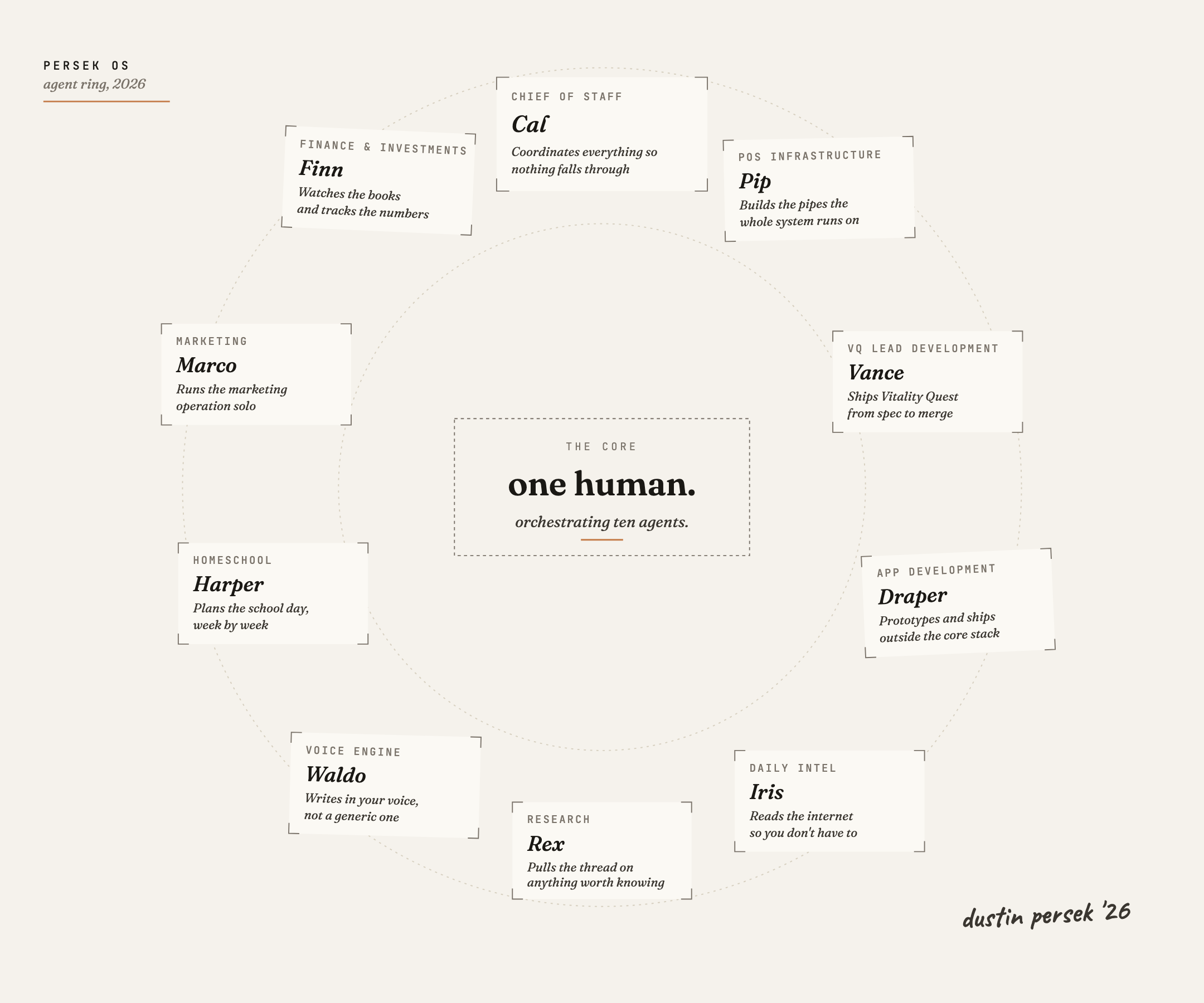
Ten agents, one council.
I have tried this a few ways: one general agent, many specialists with no coordinator, and a coordinator-first model. What has stuck is somewhere in the middle. Cal holds the cross-system view, but I often work directly with the specialist agents when the work calls for it.
Memory
Several knowledge surfaces, each with a clear boundary, plus recurring review that keeps them from drifting.
Different kinds of knowledge live in different places, with different rules for who writes, who reads, and how often things expire. The system doesn't treat memory as one bucket because real knowledge isn't one shape.
Learning Loop
Collectors without readers rot. Every signal the system captures is paired with a review path, an owner, and a human approval point before durable changes are made.
Four learning surfaces, each with its own rhythm. Different signals move at different speeds. Some improve quickly, some need review over time, and durable rules require repeated evidence.
Intelligence
Iris triages the firehose. Cal converts it into tracked work. Many sources, a lot of daily noise, and a filter tuned around what I actually care about.
By month six, the same firehose is producing a brief that looks nothing like a stranger's. The system gets quieter and more pointed as it learns what I value.
Research
Two shapes of research, one bridge between them. Rex for one-shot investigation with source-grounded synthesis. The LLM Wiki for accumulative topic knowledge that compounds over years.
Every Rex investigation makes the wiki richer. Every wiki article makes the next Rex run faster. The bridge is what keeps both sides honest.
Health
Eight layers across two classes of failure. Static rot: the system's instructions drift. Operational silence: the system keeps running without producing useful output.
Each kind of failure is silent. Both compound. Both kill trust if caught after the fact. The layers catch each kind where it actually starts.
Knowledge
Two stores share the knowledge layer. The LLM Wiki is for topics: compiled articles built from many sources. gBrain is for entities: people, projects, companies, concepts that have a life of their own and accumulate timeline.
Topics aggregate; entities persist. They stay separate so each can do its job well, and a small set of bridges keeps them connected.
Development System
The app factory and system-change lane: planning, specs, build, test, review, release, and follow-up. It covers product work like VitalityQuest, Music Bingo, and this site, plus PersekOS changes when the operating system itself needs to evolve.
The durable part is not one framework or one model. It is the workflow: scoped plans, issue tracking, code review, verification runs, docs updates, and a clear path from idea to shipped artifact.
Automation / Cadence
This is what makes the system active when no one is prompting it: morning support, Intel runs, weekly wrap, system audits, memory sweeps, skill audits, reminders, and recurring follow-ups.
Cadence does not own every job's domain truth. It owns the rhythm, registry, and monitoring expectations so recurring work remains visible instead of becoming quiet background machinery.
Work / Commitments
This is the life/work obligation layer: Todoist, Linear, calendar, daily notes, follow-ups, reminders, open loops, and closure checks. It covers more than software because PersekOS supports a real household and a real working life.
The important distinction is state. A thought can live in memory, but a commitment needs a home, an owner, and a way to prove whether it was closed.
Cross-cutting layers
The current vault model separates core subsystems from the layers that pass through all of them. Foundation, connections, interface, canon, skills, governance, and security are not side quests; they are what make the same system usable across agents, projects, and model runtimes.
- Operating Foundation keeps the system runnable across tools, agents, and recurring workflows.
- Connections / Transport links the system to the places where work, context, schedules, and communication already live.
- Interface / Review Surfaces make it legible through dashboards, notes, briefs, reports, and conversations.
- Canon / Knowledge and Skills preserve source of truth and turn workflows into reusable routines.
- Governance and Security / Privacy define what is allowed, what needs approval, and what must be protected.
Model portability
Claude Code and Codex are not the operating system. They are current AI work surfaces. Future tools only matter if they can carry the same agent canon, skills, memory, governance, and workspace model forward.
This is the strongest current architectural bet: the mechanics may change every few months, but PersekOS should remain anchored in durable canon, context, workflows, and review boundaries.